Google is undergoing a fundamental transformation from organizing information with blue hyperlinks to becoming an interface to reality itself. This 'agentic era' means search engines, Gmail, Android, and glasses are all becoming AI agents. Google has scaled from 9.7 trillion to 3.2 quadrillion tokens per month, enabled by splitting TPUs into TPU-T (training) and TPU-I (inference). Gemini Omni represents the next evolution—a world model that accepts any input and produces any output, understanding language, physics, and motion to simulate reality on demand. This shift represents a paradigm change from passive information retrieval to active, autonomous agents that can perform tasks and interact with the world.
Instala nuestra extensión para buscar dentro de cualquier video al instante
Google’s AI endgame is here… everything you missed at Google I/O 2026Indexado:
Try using Emergent's specialized agents in parallel to build any full-stack application - https://app.emergent.sh/?utm_shift=redirect&via=fireship At Google I/O 2026, Sundar Pichai and Demis Hassabis set out the roadmap for Google's 'agentic Gemini era', with Gemini hiding inside every product like the microplastics in your bloodstream. But what else did they announce? #coding #programming #google #ai 🔖 Topics Covered - Google I/O 2026 Announcements - Everything is an agent now - Google's TPU chip - Gemini Omni - Antigravity Want more Fireship? 🗞️ Newsletter: https://bytes.dev 🧠 Courses: https://fireship.dev
Yesterday, Google I/O wrapped, and I was able to watch in person as Sundar and Demis laid out an ambitious vision for the future of software. And apparently, that future is Gemini hiding inside of every product like the microplastics in your bloodstream. But the road map is basically take Gemini, append a noun to it, and ship it. Gemini Spark, Gemini Omni, Gemini Flow, and the list goes on.
But they're calling it the agentic Gemini era. The search is now an AI agent, Gmail is an AI agent, Android is an AI agent, your glasses are an AI agent. And as I watched the keynote, I realized something. That Google is no longer trying to organize the world's information with blue hyperlinks, because search engines are now an archaic technology. Instead, Google is trying to become the interface to reality itself before Anthropic and OpenAI create better realities. But luckily, Google I/O wasn't all about AI.
I didn't see any updates about Angular, but I did come across a new awesome web API that every web developer should know about. In today's video, we'll break down everything you missed at Google I/O. It is May 22nd, 2026, and you're watching The Code Report. Whether you love it or hate it, one thing is undeniably impressive about Google, and that's its ability to scale. Not only is it serving its core products to billions of daily active users, but in the last 2 years, they've gone from serving 9.7 trillion tokens per month to a staggering 3.2 quadrillion tokens per month. And that number is going to continue accelerating. In addition, Alphabet's capital expenditures have exploded, building new infrastructure to support all these stupid AI images you guys create with nano banana. You ever see a pug dressed like an accountant?
No.
You want to? Uh One thing that makes this massive scale possible is Google's TPU chip, or Tensor Processing Unit. I remember being amazed seeing a TPU at my first Google I/O back in 2018. But this week, they announced they're splitting these chips into two distinct jobs, the training and inference with the TPU-T and TPU-I. In other words, Google now has one chip that's optimized to teach a robot how to think, and another chip that's optimized for it to hallucinate search results on a global scale. The headline announcement at Google I/O though was Gemini Omni, a model that takes any input like text, video, and sound and produces any output. Demis Hassabis, who might be the smartest guy at Google, appears to be fully world model pilled because models like this don't just generate pixels anymore. They understand language, physics, motion, and everything else in your world just well enough to simulate reality on demand.
But along with this new model comes an entirely new design system for the Gemini app called Neural Expressive. At first glance, the UI looks like a simple glow up with new icons and better gradients. But what's unique about it is that it's optimized for generating UI elements on demand, like diagrams, timelines, and even mini apps that didn't exist before your prompt. Now, when it comes to Google's core large language models, they released Gemini Flash 3.5, which is not the big brain model, but the fast model. According to the trust me bro benchmarks, it performs nearly on par with Opus 4.7 and GPT-5.5, but runs at a much faster speed. Like if we look at this trust me bro diagram, we see that Flash is entirely in a quadrant of its own in terms of speed and intelligence. However, it's important to remember that this is not their top-tier model. The Gemini 3.5 Pro is still under wraps and not expected to release until later this summer, which was very disappointing to a lot of people on the internet. Speaking of disappointment though, not everybody was happy with the new direction of Google's anti-gravity IDE. Anti-gravity was formerly known as Windserve and was code for AI coding just like Cursor. And once again, following in the footsteps of Cursor, its latest version looks like an OpenAI Codex clone that's more focused on managing agents than writing code. Old school programmers might not be happy with this change, but the live demo was pretty badass. They used the tool to build a complete operating system from scratch, which took like 12 hours and billions of tokens. But then, they tried to play Doom on it and it failed due to missing drivers. However, live on stage, they had Gemini code up those drivers and within a few seconds, Doom was up and running. The most impressive part was just the sheer speed at which this thing could spit out tokens. But, the speed is not the only thing increasing.
But, the price of Gemini 3.5 Flash is three times more than the previous version and 30 times more than Gemini 1.5 Flash. It's still a lot cheaper than Claude, but not nearly as cheap as it used to be. Almost everything at IO involved AI in one way or another. But, if you're a web developer, one cool thing you should know about in Chrome is the HTML on Canvas API, which as the name implies, allows you to use HTML elements directly in a canvas now.
>> Awesome. Native HTML elements rendered into the canvas.
Woo!
That means you can build highly interactive UIs where you control every pixel with tools like WebGL and WebGPU, while simultaneously using HTML for your more basic UI elements. The only question is which AI coding model should you use to work with this API? Well, that's why you need to know about Emergent, the sponsor of today's video.
Everyone's switching between five different coding models these days, but we still need something to help us ship full stack applications that actually work. And that's exactly where Emergent can help. Right now, I'm using it to build a pull request review dashboard where I can paste in a GitHub link and get an AI summary of all the changes and risks per repo. You still start with a prompt, but instead of one LLM guessing how to build everything, Emergent spins up specialized agents to work on your app's front end, back end, database, testing, and deployment all in parallel.
You also don't need to mess with any Superbase wiring or Express boilerplate, because that one prompt sets up your app's database, auth, and APIs. If you're really into self-torture, feel free to keep scaffolding this stuff by hand, or you could just describe the tool you want and let Emergent's agents swarm build it all for you. You try it out for free at the link below. This has been the Code Report. Thanks for watching and I will see you in the next one.
Videos Relacionados

Elon Musk’s XAI, Fiber-Optic Drones & the New Era of US Defense & Winning the AI Arms Race
DefenseNow
250 views•2026-05-15
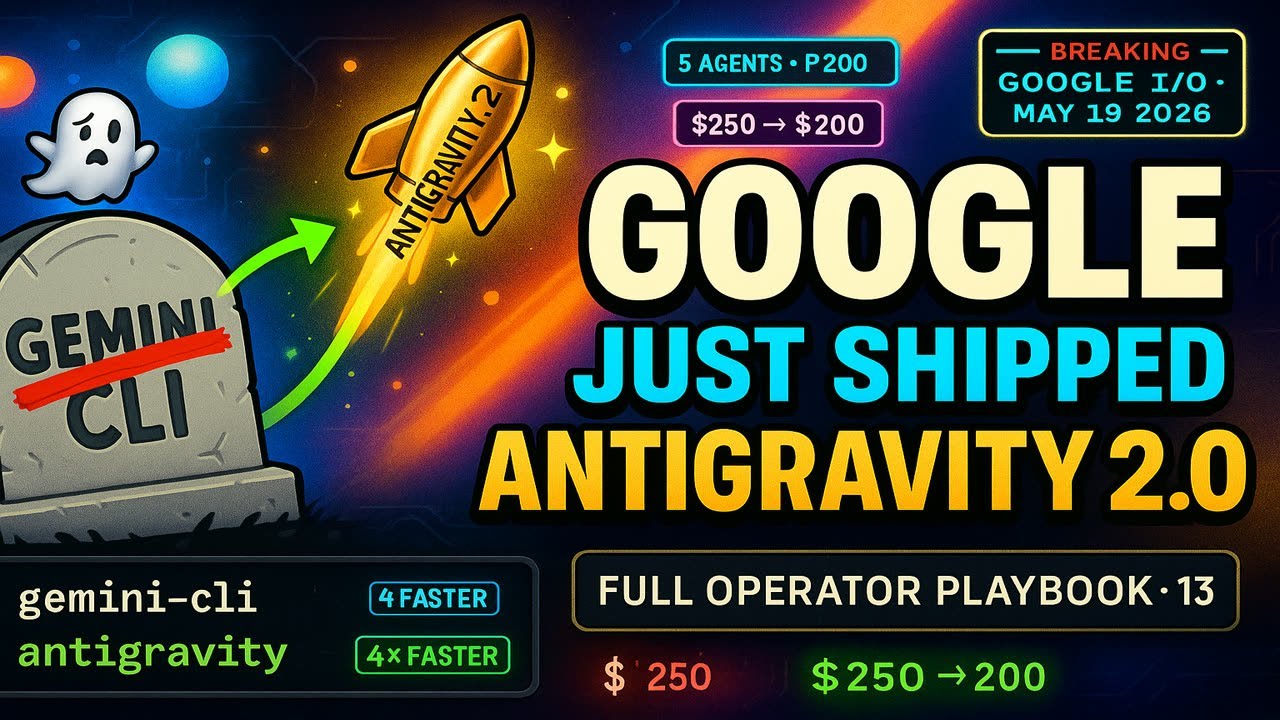
I Read Every Google Antigravity 2.0 Doc So You Don't Have To (13-Min Operator Playbook)
hyperautomationlabs1045
120 views•2026-05-19

Could AI change the future of cancer survival?
MotherConservative
999 views•2026-05-16

[RQ] All Preview 2 Midnight Horror School Deepfakes in Macbg Major
macbghuggylego
102 views•2026-05-15
Firefox on Android Just Added 'Shake to Summarize'
BrenTech
349 views•2026-05-19

Google’s NEW AI Just SHOCKED The World…
JulianGoldiePodcast
188 views•2026-05-21

WWDC 2026 Promises Apple Intelligence and Siri Upgrades | Episode 195
TheMacRumorsShow
104 views•2026-05-22

RNNs Had a Fatal Flaw — Why Transformers Replaced Sequential Processing
axiom-motion-math
567 views•2026-05-18


