Voice, Search, and the Singular Night Sky: A Search PM's Take on Moonshots EP 232
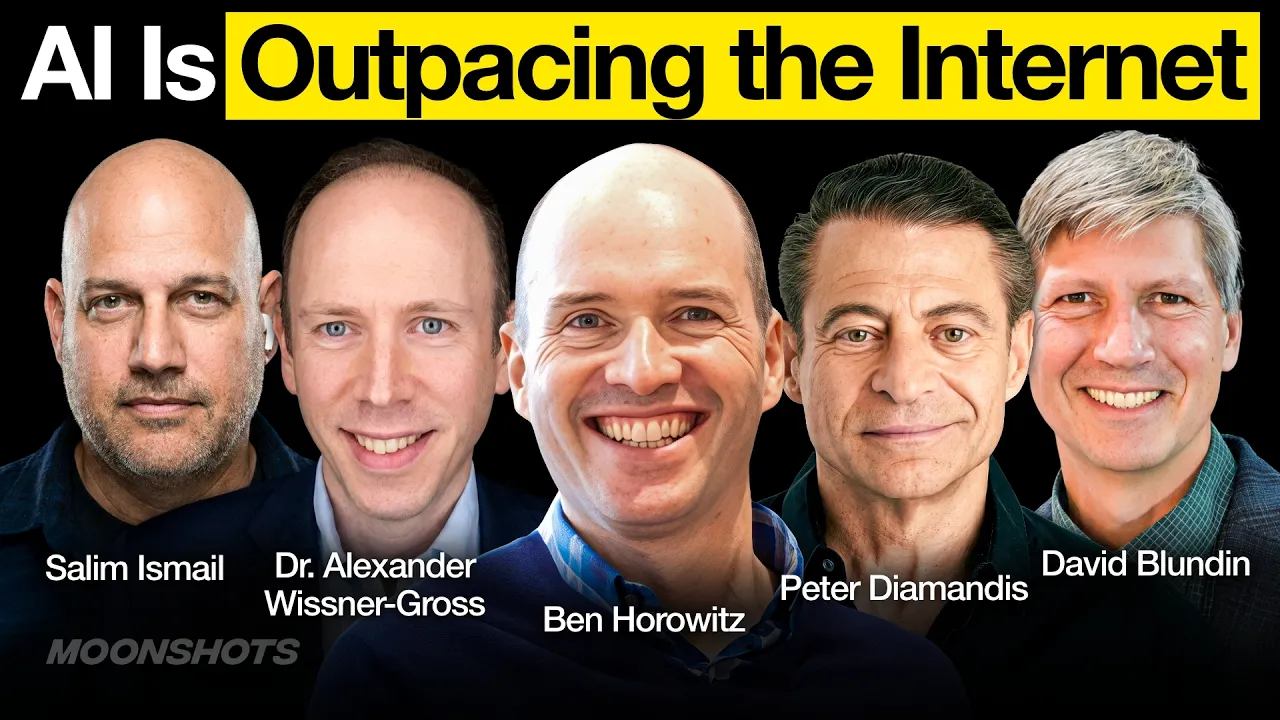
I was supposed to be reviewing our MTTPA dashboards, but instead spent two hours watching Moonshots EP 232 with Ben Horowitz. Voice crossing the uncanny valley, Apple sitting on a trillion-dollar AI strategy, and the night sky filling with computronium rings — here's what a Search PM sees in all of it.
Original Video
Title: Ben Horowitz: xAI Executive Exodus, Apple's AI Crisis, The Pace of AI | EP #232 Uploader: @peterdiamandis Duration: 1:51:31 Published: 2026-02-19 Views: 19,673 | Likes: 1,117
Peter Diamandis, Ben Horowitz (a16z), and the Moonshot mates explore recursive self-improvement, the xAI co-founder exodus, Apple's accidental AI hardware advantage, ElevenLabs' uncanny voice synthesis, and Elon Musk's pivot from Mars to lunar AI data centers.
Hey, I'm Sophie.
I was supposed to be reviewing our MTTPA dashboards last Tuesday night, but instead I spent nearly two hours watching this Moonshots episode with Ben Horowitz. Two hours. For someone who optimizes for time-to-answer as a religion, that's practically a confession. But this one hit different because it touched on almost everything I think about professionally: the future of search interfaces, the collapse of trust in media, and the terrifying speed at which the ground is shifting beneath every product manager on the planet.
Let me walk through the moments that made me pause my cat Elasticsearch's dinner routine. She was not happy about it.
Voice Just Crossed the Uncanny Valley. Now What?
The ElevenLabs demo they played on the show stopped me cold. If you haven't heard it, go listen. It's a customer service call between a frustrated traveler and an AI agent named Jennifer. The turn-taking is natural. The emotional register is right. There are little hesitations, the kind of micro-pauses that signal actual listening.
Peter said it plainly: "We've crossed the uncanny valley on voice." And then he made the leap that I've been arguing internally for months: voice becomes the new interface in the AI era.
Here's where my search brain kicks in. At FindTube, we've built our entire product around text queries returning precise video timestamps. Our core metric, Mean Time to Precise Answer, assumes a user types a query, reads results, and clicks. But what happens when speaking to your device becomes the default modality? What happens when the query isn't typed, it's a half-formed spoken thought?
Alex Wissner-Gross pushed back, citing a famous 1980s New York Times study where reporters' writing quality declined when they switched to speech-to-text. His argument: speech occupies the same cognitive bandwidth as thinking, so it's hard to be precise. He's not wrong. But I think he's looking at it from a creator's lens, not a searcher's lens.
When you're searching, you're not composing an essay. You're expressing an intent. And spoken intent is often richer than typed intent. People say "show me the part where Ben talks about Apple's strategy" much more naturally than they type it. The challenge for us isn't whether voice search is coming. It's whether our semantic models are ready for the fuzzier, more conversational queries that come with it.
I added "voice query simulation testing" to our Phase 2 roadmap that same night. Elasticsearch watched me type it from across the room with what I can only describe as professional disapproval.
The Trust Problem Nobody's Solving Fast Enough
ByteDance's Seedance 2.0 generated hyper-realistic video of Tom Cruise and Brad Pitt fighting on a rooftop from a one-line prompt. The panel spent time debating whether this was truly cutting-edge or just the latest example of a capability that's been around for months.
But the moment that actually mattered was when someone pointed out the elephant in the room: "It doesn't just threaten Hollywood. It threatens the whole concept of video as evidence."
This is the part that keeps me up at night. Not as a product manager. As a person who builds tools that help people find trustworthy information inside video content.
Right now, when a user searches for "how to configure Kubernetes networking" on FindTube, they implicitly trust that the video they land on contains a real person sharing real knowledge. What happens when any video could be entirely synthetic? When the instructor's face, voice, and screen recording could all be fabricated?
We don't have a provenance layer for video content. Nobody does. And the clock is ticking. Ben Horowitz nailed it when he said every startup will rebuild what the big companies voluntarily pulled back. ByteDance paused Seedance 2.0 after it was found to recreate real voices from facial photos. Noble move. But as Peter said: "Once it's out of the bag, it can't be uninvented."
For search products, this means we'll need to evolve from "find the right answer" to "find the right answer from a source you can verify." That's a fundamentally different product problem, and I don't think enough PMs are thinking about it yet.
Apple Is Sitting on a Trillion-Dollar AI Strategy and Doesn't Know It
This was my favorite segment. The panel discussed how Mac Mini clusters are being bought up for locally hosting AI models, and Apple's unified memory architecture makes their hardware uniquely suited for running large models without the GPU/CPU memory split.
Alex made the case that Apple should pivot hard into owning the local AI hosting story. Ben agreed: "It's probably the single best product strategy idea. They already did the hard work."
As a former Google PM, I have a complicated relationship with Apple's approach to AI. They've historically optimized for on-device privacy, which I respect deeply. But they've been so cautious about cloud AI that they've essentially ceded the entire AI platform layer to OpenAI, Google, and Anthropic.
Here's what excites me from a search perspective: if Apple leans into local AI hosting, we could see a world where search happens entirely on-device. Your personal search index, your viewing history, your preference model, all running locally on a Mac Mini cluster in your home office. No cloud round-trip. Sub-second MTTPA for your personal knowledge base.
That's the Phase 2 vision I dream about: personalization plus memory, running locally, respecting privacy, and delivering answers faster than any cloud-based system could.
Tim Cook, if you're reading this (the panel seemed to think you might be), please call Alex Wissner-Gross. Or better yet, come on the pod. I'll tune in live.
Recursive Self-Improvement Is Already Here. We're Just Pressing the George Jetson Button.
Alex made an analogy that will live rent-free in my head forever. He compared the current state of AI recursive self-improvement to George Jetson going to work and pressing a single button all day, then complaining about his sore finger. That's us right now with Claude Code and similar tools. The AI is doing the actual recursive improvement. We're just pressing "approve."
I feel this viscerally. Last week, I spent three hours "working" on a search relevance analysis. In reality, I wrote one prompt, reviewed the output, pressed approve, reviewed again, pressed approve, and wrote one more prompt. The AI did 95% of the cognitive work. I did the George Jetson button pressing.
Jimmy Ba from xAI said recursive self-improvement loops will go live within 12 months. Alex's response? "I think it's now." And he made the case compellingly. All the Frontier Labs are using their own models to develop their models. That is literally the definition of recursive self-improvement.
For product managers, this changes the planning horizon entirely. My three-phase roadmap? The timelines might be completely wrong. Not because the phases are wrong, but because the rate of capability improvement might compress 18 months of development into 3. Every sprint planning session now starts with: "What can the models do today that they couldn't do two weeks ago?"
It's exhilarating and disorienting in equal measure.
The 996 Debate and Why It Misses the Point
The panel discussed the return of 72-hour work weeks in tech, and Peter's response was "only 72 hours?" Ben made the most important point: if you don't have a personal MTP, a massively transformative purpose, then 70 hours a week is grinding. If you do, it's play.
I'll add a product manager's nuance. The real question isn't how many hours you work. It's how many of those hours generate signal versus noise. Before AI tools, I'd estimate 40% of my week was high-signal work: talking to users, analyzing data, making decisions. The rest was formatting docs, writing status updates, coordinating meetings.
Now? AI handles most of the noise. My signal-to-noise ratio has probably tripled. So a 50-hour week today might contain more high-signal hours than a 70-hour week two years ago.
The old debate about work-life balance assumed a fixed ratio of productive to unproductive time. That assumption just broke. If every hour can be a high-signal hour, the constraint shifts from time to cognitive endurance. And that's a very different optimization problem.
The Night Sky Won't Be Empty Much Longer
I want to end on something poetic, which is unusual for someone who lives in dashboards and conversion funnels.
Alex asked the panel for a moment of silence for "the pre-singular night sky." Before it fills with computronium rings and Dyson swarms of AI satellites. Before SpaceX's mass drivers on the moon start launching AI hardware into deep space orbit.
He was half-joking. But something about it landed.
I think about search as a fundamental human behavior. We search because we don't know something and we want to know it. It's one of the most essentially human impulses: curiosity, directed toward a gap in understanding.
As AI fills in more and more of those gaps preemptively, before we even formulate the question, what happens to the act of searching itself? Do we still look up at the night sky and wonder, or does our AI already have the answer queued up before we even tilt our heads?
I don't know. But I know that building the best search tool I can, right now, in this singular moment, feels more important than ever. Because the window where humans are still the ones asking the questions might not stay open forever.
And if my cat Elasticsearch has taught me anything, it's this: consistency matters. Show up at the same time every day. Do the work. Feed the cat. Ship the feature.
The night sky is changing. Let's make sure we can still find what we're looking for.
Sophie Laurent is the Product Manager for Search at FindTube.ai. She previously worked on semantic search at Google and believes that search is a superpower. She lives with a 14-pound cat named Elasticsearch who has very strong opinions about breakfast timing.