The Thinking Game: What a Documentary About DeepMind Taught Me About Running a Startup
I watched this documentary on a Saturday night after putting the kids to bed. By the end I had a notebook full of scribbles about organizational tempo, mission alignment, and the economics of patience.
Original Video
Title: The Thinking Game | Full documentary | Tribeca Film Festival official selection Uploader: @googledeepmind Duration: 1:24:07 Published: 2025-11-25 Views: 301,913,693 | Likes: 189,405
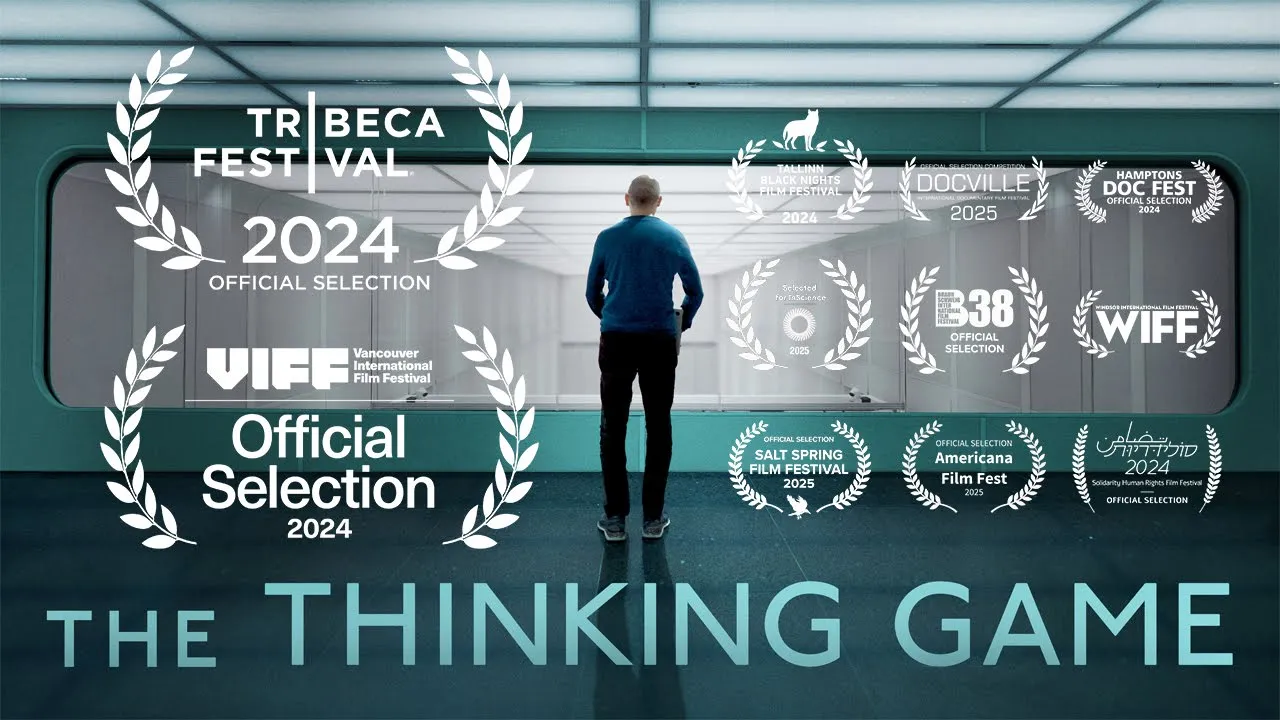
I watched this documentary on a Saturday night after putting the kids to bed. My daughter had just finished her piano recital — she's getting better, by the way, fewer duck-stepping-on-a-cat moments — and I figured I'd unwind with something light. An 84-minute film about DeepMind seemed about right.
I did not unwind. I sat there with my Leica M6 in my lap (I fidget with it when I'm thinking), and by the end I had a notebook full of scribbles about organizational tempo, mission alignment, and the economics of patience. Because while everyone else watches this film and sees the story of AI conquering Go and solving protein folding, I watched it and saw the story of a company that almost didn't survive long enough to matter.
The Pitch That Shouldn't Have Worked
There's a scene early in the film where Demis Hassabis describes pitching DeepMind to investors. "We're going to solve all of intelligence. You can imagine some of the looks I got." Shane Legg adds that investors kept asking the most prosaic question imaginable: "What's your business model?"
I laughed out loud — and then immediately felt a pang of recognition. At FindTube, we've sat in those same rooms. Not pitching AGI, but pitching something that also sounds vaguely insane to a traditional VC: "We're going to make every second of every YouTube video searchable." The looks are similar. The question is always the same: how do you make money?
Hassabis's answer was brilliant in its honesty: "We needed investors who aren't necessarily going to invest because they think it's the best investment decision. They're probably going to invest because they just think it's really cool." Peter Thiel became that investor.
Here's the operational lesson I extracted: your first investor isn't buying your product. They're buying your conviction. Thiel didn't invest in DeepMind because he understood reinforcement learning. He invested because Hassabis was the kind of person who would turn down a million pounds to go to Cambridge instead of staying at Bullfrog — someone who optimizes for the mission, not the payout.
I think about this every time we're in a fundraising cycle. The pitch deck matters less than the answer to one question: "If this fails, will you regret having tried?"
Stealth Mode and the Kidnapping Problem
The documentary reveals that DeepMind spent its first two years in total stealth. No website. Secret office location. Candidates showing up to interviews so nervous they texted their wives the address "just in case this turns out to be some kind of horrible scam and I'm going to get kidnapped."
This is funny, but it also reflects a genuine operational tension that every early-stage startup faces: how much do you reveal, and when?
At FindTube, we had a milder version of this. Our early video understanding models were rough, and we debated internally about when to go public. Show too early and you get dismissed. Show too late and someone else claims the narrative. Hassabis clearly understood that timing the reveal is as important as the technology itself — they didn't go public until they had Atari results that were genuinely impressive.
The lesson from my McKinsey days applies here: never present a half-built bridge. Nobody is impressed by the engineering of a bridge that goes halfway across a river. You wait until it connects both banks, and then you invite people to walk across it.
The Google Acquisition: Trading Upside for Velocity
The film touches on the Google acquisition — 400 million pounds — and Hassabis's reasoning: "Our investors didn't want to sell, but we decided that this was the best thing for the mission."
This is the hardest kind of decision a founder makes. You're trading future upside for present velocity. DeepMind needed compute that no startup budget could buy. Google had it. The math was simple, even if the emotion wasn't.
What struck me was Hassabis's framing. He didn't say "we needed the money." He said "there's no time to waste" and then asked a haunting question: "How many billions would you trade for another five years of life to do what you set out to do?"
That's not a financial calculation. That's an existential one. And I think it reveals something about the kind of leader Hassabis is — someone who measures success not in equity percentages but in proximity to the mission. Whether you agree with his decision or not, the clarity of his reasoning is admirable.
At FindTube, we haven't faced this exact fork in the road yet. But I've gamed it out in my head many times. My "toxicity test" for any acquisition offer would be: does this accelerate the mission by more than it constrains it? If the answer is yes, you take the deal and don't look back.
AlphaGo: The Art of the Irreversible Bet
The AlphaGo section of the film is where the operational stakes become visceral. Hassabis chose to challenge Lee Sedol — one of the greatest Go players alive — in a public, televised match. If AlphaGo lost, DeepMind's credibility would take a serious hit. If it won, the world would pay attention.
This is what I call an irreversible bet. You can't un-play a public match. You can't un-lose on live television. The risk-reward calculation requires extreme confidence in your preparation — and Hassabis had it.
What I noticed, though, is that the confidence wasn't blind. The film shows Hassabis saying "I figured at least it'll make a good showing. Good for a startup." He had calibrated his downside. Even a close loss would demonstrate that DeepMind's approach was viable. The only catastrophic outcome would be a blowout — and their internal testing suggested that wouldn't happen.
This is exactly how I think about product launches. Before every major release at FindTube, I run what I call a "pre-mortem": what's the worst thing that could happen, and can we survive it? If the answer is yes, we ship. If the answer is "we'd lose all credibility with our user base," we wait.
Move 37 — the move that no human would have played, that AlphaGo itself assessed as a 1-in-10,000 probability from a human player — is the moment the documentary crystallizes into something more than a tech story. It becomes a story about discovery. The system found something new in a game that had been studied for thousands of years.
I keep thinking about what our equivalent of Move 37 would be. What if our video search model surfaces a connection between two pieces of content that no human curator would have made? That's the promise of AI-assisted search — not just finding what you're looking for, but finding what you didn't know to look for.
AlphaFold: The Anatomy of a Near-Failure
The AlphaFold arc is, operationally, the most instructive part of the entire film. Here's why.
DeepMind entered CASP 13, the protein folding competition, and won. They beat the second-place team by nearly 50%. By any normal standard, this was a triumph. But then a biologist looked at the results and said, essentially: your predictions aren't good enough to actually use.
Hassabis's reflection is devastating in its honesty: "We were the best in the world at a problem the world's not good at." And the analogy that follows: "It doesn't help if you have the tallest ladder when you're going to the moon."
I have never heard a better description of the gap between benchmark performance and real-world utility. At FindTube, our ML team would recognize this instantly — Ben talks about it all the time. You can have the best timestamp prediction accuracy on your internal test set and still produce results that users find useless. The metric isn't the product. The product is the product.
What happened next is where the operational lesson lives. Hassabis didn't give up. He also didn't just throw more compute at the same approach. He restructured: created a "strike team," brought in domain experts (computational biologists who actually understood proteins), rewrote the entire data pipeline, and gave the team psychological cover to fail and iterate.
The film shows team members saying things like "the opinion of quite a few people on the team was that this is a fool's errand" and "I felt disappointed." These are not the words of a team riding high on momentum. These are the words of a team in the valley of despair — that crucial trough between initial excitement and eventual breakthrough that every ambitious project passes through.
As a COO, managing teams through that valley is probably the single most important thing I do. You can't fake optimism — smart people see through it. But you can provide structure, clarity, and the assurance that failure is data, not destiny. Hassabis did this by reframing the goal: "It's about proving we can solve the whole problem." Not "we need to win CASP 14." Just: prove the problem is solvable.
And then they did.
The Decision That Made It Matter
The moment in the film that hit me hardest wasn't the CASP 14 victory. It was the conversation afterward, when Hassabis asked how long it would take to fold every known protein sequence. The answer: a month. And his response: "Why don't we just do that? And then release it."
Not "let's build a service and charge per query." Not "let's partner with pharma companies for exclusive access." Just: fold everything, give it to everyone, for free.
This is a decision that only makes sense if your primary metric is impact, not revenue. And it's the kind of decision that, frankly, is very hard to make when you're a startup burning cash. DeepMind could do it because Google was absorbing the cost. Most companies can't.
But the principle underneath is transferable: the fastest way to become indispensable is to be generous with your best work. At FindTube, we've made similar (smaller-scale) decisions — open-sourcing certain components, offering free tiers that are genuinely useful rather than crippled teasers. It's not charity. It's strategy. The 200 million protein structures that AlphaFold released for free created a global ecosystem of researchers who now depend on DeepMind's technology. That's a moat no competitor can cross.
The Rhythm of Breakthroughs
One thing the documentary captures beautifully is the temporal rhythm of scientific progress. Months of nothing, then sudden leaps. Hassabis estimates AGI requires "about a dozen" major breakthroughs. Each one is unpredictable in timing but inevitable in sequence — you can't skip steps.
This maps directly to how I think about company building. Growth isn't linear. It comes in bursts separated by plateaus that feel interminable. The plateaus are where most companies die — not from lack of potential, but from loss of faith.
My job as COO is to manage the company's metabolism through these cycles. During plateaus, you conserve cash, tighten processes, invest in infrastructure that will matter when the next burst comes. During bursts, you sprint — hire fast, ship fast, capture the moment. The trick is knowing which phase you're in.
Hassabis seems to have an almost supernatural sense for this. The film shows him saying "I know what that moment means now and I know this is the time now to press." That's pattern recognition earned through decades of competitive experience — chess tournaments, game development, startup building, research management. You can't teach it. You can only accumulate it.
What Kept Me Up
The film ends with Hassabis reflecting on AGI and the weight of responsibility. "If you received an email saying this superior alien civilization is going to arrive on Earth, there would be emergency meetings of all the governments." The implication: we should be treating AI with the same urgency.
I don't work on AGI. I work on video search. But the film left me thinking about something smaller and more personal: the responsibility of building something that people rely on. Every day, users come to FindTube expecting to find the exact moment in a video that answers their question. That's a small trust, compared to solving protein folding. But it's still a trust.
Hassabis turned down a million pounds at 17 because he knew Bullfrog wasn't the right use of his life. He sold DeepMind for less than it was worth because he knew speed mattered more than valuation. He released AlphaFold's predictions for free because he knew impact mattered more than revenue.
Every one of those decisions was about trading something measurable for something that couldn't be measured. That takes a kind of courage that no business school teaches.
I put the Leica down, closed my notebook, and went to check on the kids. My son had kicked off his blanket. My daughter's piano sheet music was still on the stand, open to the piece she'd played that evening. Small, imperfect, beautiful things.
Not every thinking game has to change the world. But the ones that do start with someone deciding that the game is worth playing — even when the odds say otherwise.
— Marcus Chen, COO @ FindTube.ai