Steve Jobs Already Knew the Growth Playbook in 1995 — He Just Didn't Call It That
I found this interview at 2 AM during one of those rabbit holes. A VHS copy of a 1995 Steve Jobs interview, lost for years, found in a director's garage. I expected nostalgia. What I got was a masterclass in every growth principle I use daily.
Original Video
Title: Steve Jobs - The Lost Interview (11 May 2012) [VO] [ST-FR] [Ultra HD 4K] Uploader: @tvarchive7927 Duration: 1:06:30 Published: 2024-03-30 Views: 56,048 | Likes: 1,193
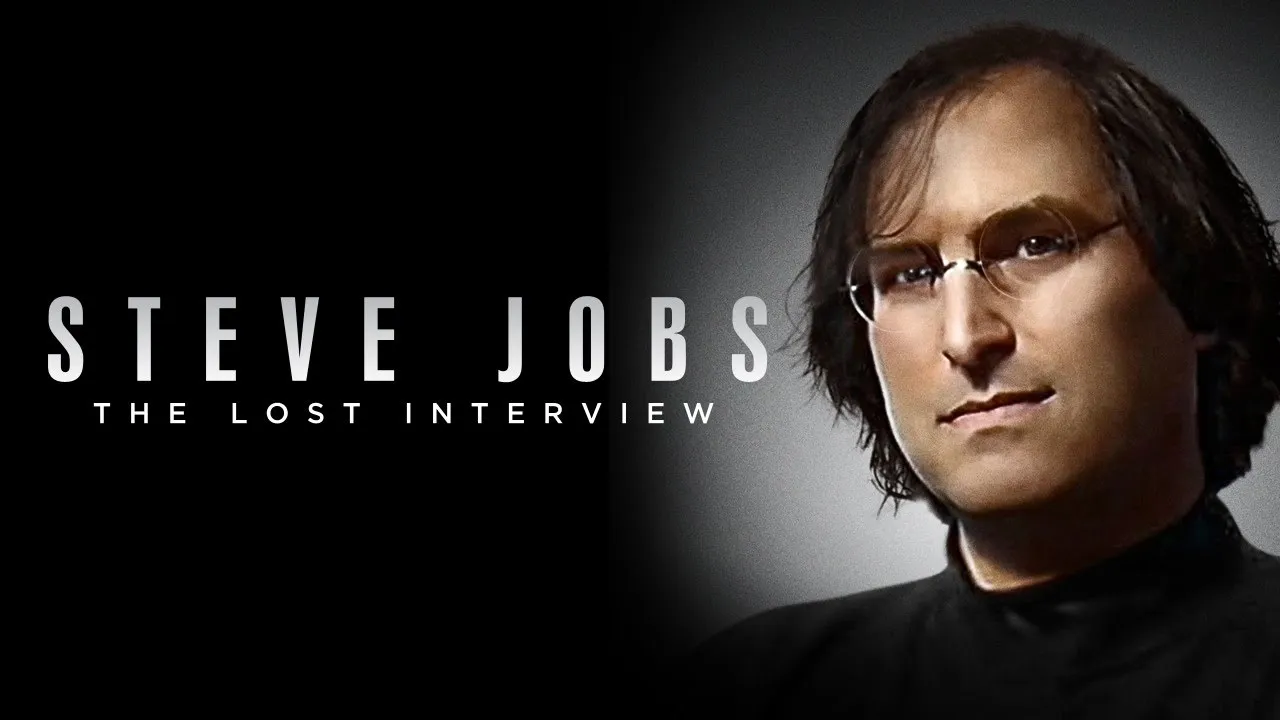
I found this interview at 2 AM during one of those rabbit holes you fall into when you're supposed to be reviewing experiment results. A VHS copy of a 1995 Steve Jobs interview, lost for years, found in a director's garage. The whole thing is uncut, unpolished, and raw in a way that modern tech interviews never are.
I expected nostalgia. What I got was a masterclass in every growth principle I use daily — articulated 30 years ago by a guy who would have found the term "growth hacking" insufferable.
Blue Boxes and the First Growth Loop
Jobs opens with the blue box story — how he and Wozniak built devices to make free phone calls by mimicking AT&T's signaling tones. Most people hear this as a fun hacker anecdote. I heard something else entirely.
"We could build something ourselves that could control billions of dollars' worth of infrastructure in the world."
That's not a prank story. That's a lesson in leverage — the core principle underneath every growth loop I've ever designed. A tiny input (a small electronic box) producing a massively disproportionate output (controlling the global telephone network). That's what a viral coefficient greater than 1 looks like, expressed in hardware.
But the real insight is what Jobs says next: "I don't think there would have ever been an Apple computer had there not been blue boxing." The blue box wasn't a product. It was a proof of concept for a mindset — that two kids in a garage could build something that interfaces with systems orders of magnitude larger than themselves.
At FindTube, I think about this when we design our Chrome extension or our embeddable search widget. These are small things — trivially small compared to YouTube's infrastructure. But they give individual users leverage over millions of hours of video content. That's the blue box principle: build a small thing that gives people control over a big thing.
The Byte Shop and Net 30: Accidental Product-Led Growth
The Apple I origin story is basically a case study in product-led growth (PLG), except nobody had invented that term yet.
Here's the sequence: Jobs and Wozniak build computers for themselves. Friends want them. Building each one takes 40-80 hours. They can't keep up. So they make printed circuit boards to reduce assembly time — and sell the boards to friends at cost to recoup their investment.
Then Paul Terell at the Byte Shop says: "I'll take 50, but I want them fully assembled."
Jobs didn't plan for this. He didn't have a go-to-market strategy. He didn't run an A/B test on pricing. He just said, "Why not try this?" — bought parts on net 30 credit, built 50 units, sold them in 29 days, paid off the suppliers in 30 days. Instant business.
What I love about this is the purity of the growth loop:
- Build for yourself (authentic product-market fit)
- Friends want it (organic word-of-mouth — K > 0)
- Reduce friction (printed circuit boards cut build time from 80 hours to a few)
- Channel discovers you (the Byte Shop, not the other way around)
- Credit gives you runway (net 30 as proto-seed-funding)
Every PLG company in 2026 is trying to engineer this exact sequence. Jobs stumbled into it in a garage in 1976. The lesson isn't "be lucky." The lesson is: if your product genuinely solves your own problem, the first growth loop is already built into your behavior.
At FindTube, our earliest users were ourselves — people who were tired of scrubbing through hour-long coding tutorials. We didn't need to invent a use case. We were the use case. That's the strongest possible foundation for growth, and it's exactly what Jobs describes.
"Nobody Knows Why They Do What They Do"
There's a moment in the interview where Jobs talks about learning to run a company at 21, and he says something that stopped me cold:
"I'd always ask why you do things. And the answers you invariably get are, 'Oh, that's just the way it's done.' Nobody knows why they do what they do. Nobody thinks about things very deeply in business."
He gives the example of "standard cost" accounting — a system where you guess your costs, then fix your guess at the end of the quarter. He kept asking why, and after six months discovered the real answer: the information systems weren't good enough to track actual costs in real time. So everyone just... guessed. And nobody questioned it.
This is the 5 Whys method, decades before Toyota made it fashionable in Silicon Valley. And it's exactly the discipline I try to bring to growth experiments at FindTube.
Every week, when someone proposes an experiment, I ask: "Why do we think this will work?" Not "what's the hypothesis" — that's the sanitized version. I mean: why, really? Is it because the data suggests it, or because some blog post said it works, or because a competitor does it? Most of the time, the honest answer is closer to "that's just the way it's done" than anyone wants to admit.
Jobs found that if you're willing to ask questions and think deeply, "you can learn business pretty fast. It's not the hardest thing in the world." That's both liberating and terrifying — liberating because it means first principles thinking actually works, terrifying because it means most of your competition isn't doing it.
The 50-to-1 Dynamic Range
The single most quotable insight in the entire interview, and the one I've shared with more people than any other, is Jobs on talent:
"In software, the difference between average and the best is 50 to 1, maybe 100 to 1. Very few things in life are like this."
He then describes how finding A players creates a self-reinforcing loop: A players like working with other A players, they refuse to work with B and C players, so they only hire more A players, "and it propagates."
This is, structurally, a viral growth loop applied to hiring. K > 1 among A players. The "product" is the team itself — and once it reaches critical mass, it becomes self-sustaining.
I've seen this at Instagram and I see it at FindTube. When Aisha (our VP of Growth) hired me, she was explicit: "I'd rather leave a role open for six months than fill it with someone who's 'good enough.'" That felt extreme at the time. Now I understand — a B player in a growth role doesn't just underperform, they lower the bar for everyone around them. They make the A players question whether this is a place worth being.
The inverse is also true. When you have a team of people who are all operating at a high level, the energy is different. Experiments are sharper. Critique is more honest. Nobody needs to be coddled. Jobs says it directly: "When you get really good people, they know they're really good, and you don't have to baby people's egos."
That maps to something I believe deeply: growth teams should optimize for learning speed, not ego protection. If an experiment fails, we don't need a 30-minute feelings debrief. We need to understand why it failed and run the next one.
The Rock Tumbler and the Team
Jobs tells a story about a neighbor who showed him a rock tumbler — ugly stones go in, beautiful polished stones come out. His metaphor: a team of passionate people is like that tumbler. "Through rubbing against each other, having arguments, having fights sometimes, making some noise — they polish each other and they polish the ideas."
This is the most honest description of high-performing team dynamics I've ever heard. It's not comfortable. It's not "psychologically safe" in the HR-approved sense. It's friction — deliberate, constructive, intense friction — that produces quality.
I think about this during our Tuesday growth meetings. The best experiments come from the sharpest disagreements. When someone pushes back on a hypothesis and forces the proposer to defend it with data — that's the tumbler working. When everyone nods politely and says "sounds good" — that's when we ship experiments that teach us nothing.
The key insight Jobs adds: "It's certainly not the result of one person. People like symbols — I'm the symbol of certain things. But it really was a team effort."
Coming from the most iconic individual in tech history, that admission carries weight.
The Xerox PARC Lesson: Seeing vs. Understanding
Jobs visited Xerox PARC in 1979 and saw three things: object-oriented programming, networked computing, and the graphical user interface. He says he was "so blinded by the first one" — the GUI — that he didn't even register the other two.
Two things strike me about this.
First: even Steve Jobs had attention blindness. He saw three revolutionary technologies and could only absorb one. This is humbling for anyone who thinks they can evaluate multiple opportunities simultaneously. You can't. Your brain will latch onto the most viscerally exciting one and filter out the rest.
In growth, this manifests as fixating on one metric or one channel while ignoring signals elsewhere. I've caught myself doing it — obsessing over our viral coefficient while our email activation sequence was quietly hemorrhaging users. The data was there. I just wasn't looking because I was blinded by the shinier number.
Second: Xerox had all three innovations and commercialized none of them. Jobs's explanation is devastating: monopolies promote sales and marketing people over product people, and eventually "the product sensibility that brought them to that monopolistic position gets rotted out."
This is the most important thing any growth PM can hear: growth without product excellence is a dead end. You can optimize every funnel, nail every channel, achieve K > 1 — but if the product itself has lost its soul, you're just accelerating toward a cliff. Growth serves the product. Never the other way around.
"The Computer Is the Bicycle of the Mind"
Near the end, Jobs talks about an article in Scientific American that measured the efficiency of locomotion for various species. The condor won. Humans were unimpressive — about a third of the way down the list. But a human on a bicycle blew away everything, including the condor.
"Humans are tool builders, and we build tools that can dramatically amplify our innate human abilities."
This is the framing that connects everything Jobs says in this interview — from blue boxes to the Macintosh to the web. The computer is a bicycle for the mind: a tool that amplifies what you can already do.
At FindTube, this is the framing I keep returning to. We're not replacing human curiosity. We're giving it a bicycle. When someone watches a 3-hour conference talk and wants to find the 45 seconds where the speaker explains a specific concept — that's a human impulse. We just make it possible to act on that impulse in seconds instead of minutes.
Jobs ends with something about taste — that ultimately, building great products "comes down to trying to expose yourself to the best things that humans have done and then try to bring those things into what you're doing." Musicians, poets, artists, zoologists, historians — all working on the Macintosh.
I collect and repair mechanical watches. A 1970s Seiko diver. A 1950s Universal Geneve. Watchmaking has taught me more about growth funnels than any analytics course — because a watch is a system where tiny imperfections accumulate. A speck of dust on a pivot, a hairspring that's slightly out of true, a worn gasket — each individually negligible, but together they stop the watch. Growth funnels work the same way. Small frictions in onboarding, a confusing CTA, a slow-loading page — each one trivial, together they collapse your conversion rate.
Jobs would have called that "taste" — the ability to sense when something is slightly wrong even before you can articulate why. I call it "tolerance stack-up." Same thing, different vocabulary.
Why This Interview Matters in 2026
This interview was recorded 31 years ago. Jobs was running NeXT, a $50 million company that most people had written off. Apple was dying — his words, not mine. He had no idea he'd be back within 18 months.
And yet everything he says — about leverage, about product-market fit, about asking why, about A players, about taste, about the web as "the defining social moment for computing" — aged perfectly. Not because he was prophetic, but because he was thinking at the level of principles, not tactics.
Tactics expire. "Run Facebook ads" was brilliant advice in 2015 and mediocre advice in 2025. But "build a small thing that gives people control over a big thing"? That's timeless. "Growth is removing obstacles, not adding persuasion"? Timeless. "The product sensibility that built the monopoly gets rotted out by people who don't understand product"? Happening right now, at companies I could name.
I finished the interview at 4 AM. My experiment results were still unreviewed. I poured another coffee, opened the dashboard, and started asking: why are we running this experiment? Not "what's the hypothesis." Why. Really why.
Jobs would have approved. Or he would have told me my experiment was not good enough. Either way, I'd have learned something.
— Ryan Kim, PM Growth @ FindTube.ai